
Search Visibility Strategy: How to Protect Leads When Google Changes the Rules
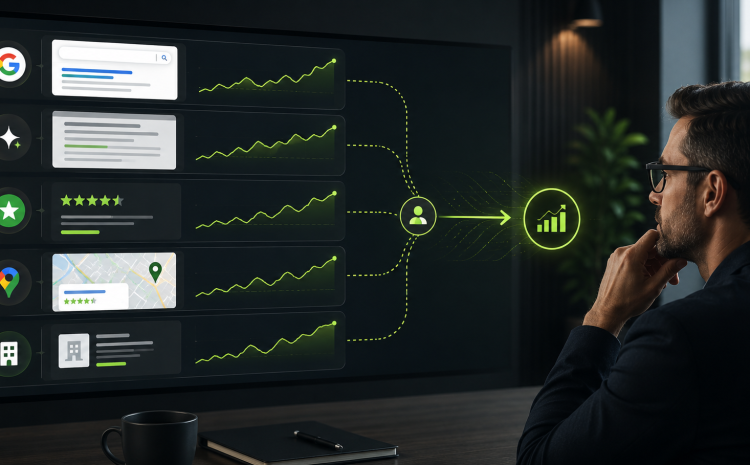
Rankings can look perfectly stable while qualified leads quietly slow down. A search visibility strategy in 2026 has to account for more than where a page sits in Google results. Buyers now evaluate businesses through AI summaries, reviews, maps, and third-party sources before visiting any website.
Google has already released two broad core updates in 2026. According to Search Engine Land, the May 2026 core update caused significant ranking volatility across industries, with nearly 80% of top results shifting in affected categories. Each update is a reminder that relying on a single channel is a business risk, not a strategy.
For business leaders, the question is straightforward: when search shifts, can the right buyers still find your business and trust it enough to reach out?
What a Search Visibility Strategy Actually Protects
Rankings no longer tell the full story
A buyer researching a vendor in 2026 rarely starts and ends with a Google search. They may read an AI-generated summary, check a Google Business Profile, scan review scores, or find a comparison article before visiting your website.
Each of those is a moment where your brand either shows up clearly or does not. A strong search visibility strategy means being found and trusted across all those touchpoints, not just ranking on page one of Google.
When visibility weakens, leads follow
The damage rarely announces itself as a traffic collapse. It arrives as a gradual shift in lead quality. Fewer high-intent inquiries. Slower sales conversations. More pressure on paid campaigns to fill the gap.
By the time the pipeline shows the impact, search has been affecting the business for weeks. That delay is why treating search as a set-and-forget investment is a costly assumption.
The Three Foundations of a Durable Search Visibility Strategy
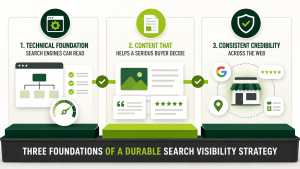
A technical foundation search engines can read
Before a page can rank or appear in AI-supported results, Google needs to find it and understand what it contains. Google’s own core update documentation confirms that ranking drops after core updates often reflect content quality issues rather than technical failures, but pages that are slow, buried, or blocked still cannot compete regardless of content quality.
Service pages, location pages, and high-intent landing pages deserve the most attention. These are the pages most likely to bring qualified buyers into the business, and they need to be accessible, fast, and clearly structured.
Content that helps a serious buyer decide
Publishing more content does not automatically create stronger visibility. The risk grows when AI summaries answer basic questions quickly, leaving generic pages with less to offer.
Content that is specific, useful, and backed by proof performs better across both traditional and AI-influenced search. A simple test: would this page give a serious buyer enough to decide whether your company is the right fit? If not, it may attract visits without generating real opportunities.
Consistent credibility across the web
Search engines and AI systems look beyond your website. Buyers do the same. They check review platforms, directory listings, author bios, and third-party mentions. When all of those sources describe your business in the same clear way, the result is a trust signal that strengthens your search visibility strategy over time.
Inconsistency across those sources creates uncertainty. AI systems treat uncertain sources as less reliable, and less reliable sources get recommended less often.
How Prospect Factory Builds a Search Visibility Strategy
Starting with a diagnostic, not assumptions
An effective search visibility strategy starts with understanding what buyers are actually searching for across platforms. Our Big Data Social Listening service maps those conversations in real time across social platforms, forums, and communities. That intelligence drives smarter content and faster responses to emerging topics.
Our Adaptive and Intelligent SEO practice then builds the technical and content foundation that supports long-term visibility. That includes page structure, content architecture, schema markup, and third-party credibility signals that hold up across Google updates, not just the current one.
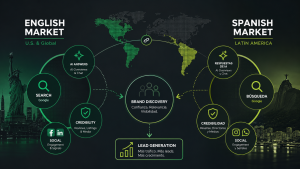
Visibility in both English and Spanish markets
For organizations operating across US and Latin American markets, search visibility has an additional layer. Google indexes and ranks content differently across languages. AI systems also draw from different source pools when generating answers in English versus Spanish.
A brand that maintains strong credibility signals in English but not in Spanish misses a significant share of buyers at the discovery stage. Our Social Media Contents service supports this by extending brand presence across the social platforms that feed both Google and AI search signals in each language.
If you want to understand where your current search visibility strategy has gaps and which changes would protect lead flow most directly, we welcome that conversation. Reach us at prospectfactoryonline.com/contact-us.
Frequently Asked Questions
What is a search visibility strategy?
A search visibility strategy is a plan for ensuring your business can be found, evaluated, and trusted across all the places buyers look before making contact. That includes Google search results, AI-generated summaries, review platforms, maps, and directory listings. In 2026, ranking well on Google is one part of that strategy, not the whole of it.
Why do Google core updates affect lead flow?
Core updates change how Google evaluates and ranks content across the web. When important pages lose visibility after an update, the business typically sees fewer qualified visitors reaching service and landing pages. That shift often shows up first as a drop in lead quality rather than a dramatic traffic decline, which makes it easy to miss until the pipeline is already affected.
How often does Google update its search algorithms?
Google releases broad core updates multiple times per year, alongside smaller unannounced changes throughout. In 2026 alone, Google released core updates in March and May, both of which caused significant ranking movement across industries. A search visibility strategy needs to be durable across these cycles, not just optimized for current conditions.
Does this apply to B2B companies?
Yes. B2B buyers follow multi-channel research patterns before contacting any vendor. They use Google, LinkedIn, review platforms, and AI tools to build a shortlist. B2B organizations that only focus on Google rankings miss the other moments where buyers form impressions and decide who to contact. A complete search visibility strategy accounts for each of those moments.
How does Prospect Factory approach search visibility for businesses in US and Latin American markets?
Prospect Factory starts with a real-time map of what buyers are searching for and discussing across platforms in both English and Spanish. From there, we build a strategy that addresses the technical foundation, content structure, and credibility signals that support visibility across Google, AI search tools, and social platforms in both markets.

