
Google Search Ranking Volatility in April 2026: What Business Leaders Need to Know
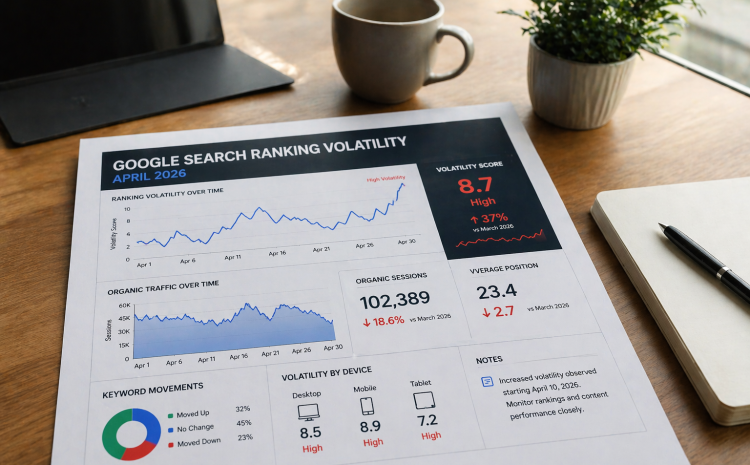
Google search ranking volatility is rising again in April 2026. For many organizations, traffic numbers are shifting in ways that are hard to explain without context. This article gives business leaders that context, without the technical jargon.
Google completed the March 2026 core update on April 8. Within two weeks, multiple SEO tracking tools began showing fresh ranking movement. That pattern is not unusual after a major update, but the timing matters.
If your organization depends on organic search traffic, this is a moment worth paying attention to. Not to panic, but to understand what is happening and what a measured response looks like.
What Google Search Ranking Volatility Actually Means for Business
Rankings move, but not all movement means the same thing
Ranking volatility describes the rate at which Google rearranges search results. When volatility is high, pages that ranked in position 3 yesterday may rank in position 8 today. Some recover. Others do not.
For business leaders, the important distinction is between temporary fluctuation and sustained loss. A single bad week during a known update period often stabilizes. A pattern of declining traffic across several weeks usually reflects something more structural that warrants a real response.
Google itself documented the March 2026 core update on its Search Status Dashboard, confirming the rollout ran from March 27 to April 8. That official record is the right baseline for evaluating any traffic changes your organization saw during that window.
What core updates actually change
Core updates are not penalties. Google does not target individual sites for punishment. Instead, it recalibrates how it evaluates content across the entire web.
Pages that served a search well under the previous system may now face stronger competition. Pages that were undervalued before may gain ground. The shift affects relevance signals, trust indicators, and how well a page matches what the searcher actually wants.
Search Engine Journal’s coverage of the March 2026 core update completion noted that Google called it ‘a regular update designed to better surface relevant, satisfying content.’ That description matters. It tells organizations what Google is rewarding: depth, relevance, and genuine usefulness.
What the April 2026 Google Search Ranking Volatility Signals
Three updates in five weeks changed the baseline
The April volatility did not arrive in isolation. Google ran three separate updates in roughly five weeks. The February 2026 Discover core update finished on February 27. The March 2026 spam update completed on March 24 in under 20 hours. The March core update followed three days later.
That sequence matters for any organization trying to interpret what happened to their traffic. A drop that started in late March could reflect the spam update, the core update, or both. Separating those causes requires comparing specific date ranges in Google Search Console, not just looking at monthly totals.
The April volatility appears to be late-stage recalibration from the March core update. Rankings often continue settling for several weeks after a named update officially ends. That is normal, and it does not necessarily signal another major rollout.
Google search ranking volatility exposes content weaknesses faster
One consistent pattern across core updates in 2025 and 2026 is that volatility tends to surface weaknesses that existed before the update. Pages with thin content, poor intent matching, or weak topical depth lose more ground during volatile periods than pages built on solid foundations.
This is why the same update can produce very different results across different organizations. A company with a well-structured content program and strong search presence may see minimal disruption. A company with inconsistent publishing and generic content may feel significant movement even on previously stable pages.
Our Adaptive and Intelligent SEO practice is specifically designed for this environment. We build search programs that hold up through update cycles rather than programs that perform well only in stable conditions.
How Organizations Should Respond Right Now
Measure before changing anything
The most common mistake during volatile periods is making fast, wide changes without enough data. Rewriting pages, deleting content, or restructuring the site during an active volatility window can make the situation worse.
The right first step is measurement. Open Google Search Console. Compare the period before March 27 against the period after April 8. Look for patterns across page types and topic clusters, not just individual URLs.
A comprehensive website audit gives organizations a structured view of where their current search presence is strong and where it is exposed. That analysis is the foundation for any real response to Google search ranking volatility, not guesswork based on a single week of data.
Protect paid visibility while organic stabilizes
When organic rankings shift, paid search becomes more important as a short-term bridge. Organizations that already run Google Ads can increase visibility on key commercial terms while organic performance stabilizes.
Our Certified Google Ads practice helps organizations use paid search strategically rather than reactively. For teams seeing organic drops on high-value terms, this is the right time to review coverage and ensure no revenue-critical queries are going unaddressed.
Use this moment to assess the broader strategy
Volatility periods are disruptive, but they also reveal something useful. They show which parts of an organization’s digital presence are resilient and which parts depend on favorable conditions that can change at any time.
Organizations that come out of volatile periods stronger are typically those that use the disruption to prompt a real digital business strategy review. That review maps the current search presence against growth objectives and identifies where investment produces durable results rather than temporary rankings.
At Prospect Factory, we work with organizations that need their search presence to perform consistently across update cycles, not just during calm periods. If April’s volatility has your team asking hard questions about your search strategy, we welcome that conversation at prospectfactoryonline.com/contact-us.
Frequently Asked Questions
What is Google search ranking volatility?
Google search ranking volatility refers to the rate at which search results change over a short period. When volatility is high, many pages move up or down in rankings faster than usual. This often happens during or after a major Google update. It does not automatically mean a site has been penalized.
What caused the April 2026 search volatility?
The April 2026 volatility appears to be continued recalibration following the March 2026 core update, which ran from March 27 to April 8. Rankings often continue settling for several weeks after a major update officially ends. This followed the February 2026 Discover core update and the March 2026 spam update, making it a particularly active period for search changes.
Does a ranking drop after a Google core update mean my site was penalized?
No. Core updates are broad recalibrations of how Google evaluates content quality across the entire web. A drop means Google currently sees other pages as a better match for certain queries. It is not a policy violation or targeted action against your site. Recovery requires improving how well your content serves the searcher’s actual intent.
How long does ranking volatility last after a Google core update?
Rankings typically continue shifting for two to four weeks after a core update officially completes. Some sites see movement for longer. Google also runs smaller, unannounced updates continuously between major rollouts. This is why measuring performance over 30 to 60 day windows gives a more accurate picture than day-to-day comparisons.

