
Content for AI Search: Why Structure Now Determines Who Gets Found
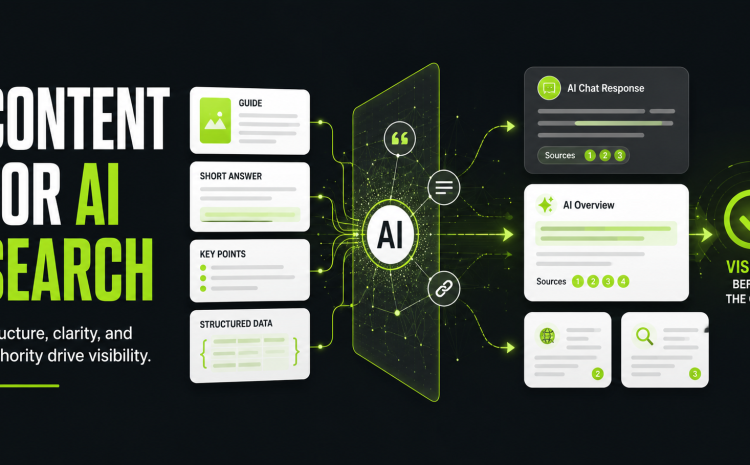
Most organizations publish content with one goal: rank higher on Google. That goal is no longer enough. Content for AI search requires a different approach, because AI tools now shape how buyers discover and evaluate businesses before any website visit happens.
The numbers confirm the shift is material. According to 42 verified statistics on AI search referral traffic compiled by The Stacc, AI-referred sessions grew 527% in just five months across 2025. More relevant for business leaders: visitors from AI platforms convert at 4.4 times the rate of organic search visitors.
The question is not whether AI search matters. It is whether your content is structured to appear in it.
What Content for AI Search Actually Needs to Do
Content for AI search is evaluated before the click
When a buyer uses ChatGPT, Perplexity, or Google AI Overviews to research a vendor, they receive an AI-generated summary. That summary draws from sources the AI considers credible and clear. The buyer forms an impression, narrows their shortlist, and may contact a business without visiting more than one website.
Your content plays a role in that process or it does not. If AI tools cannot extract a clear, credible answer from your pages, your brand does not appear in the moment buyers are deciding.

Why most existing content fails AI systems
Most B2B content was built for a different era. It performs adequately in traditional search but fails in AI environments for a specific reason: the main point arrives too late. According to Superlines’ 2026 analysis of over 60 AI search statistics, 44% of all AI citations come from the first 30% of a page. Content that opens with context before stating its point loses citation opportunities before the AI reaches the useful section. That is a structural problem, not a writing problem.
The same research found that around 80% of URLs cited by AI systems do not rank in Google’s top 100 results for the same query. Ranking well does not guarantee AI visibility. Different signals determine each outcome.
The Structural Changes That Drive AI Visibility
Front-load the point
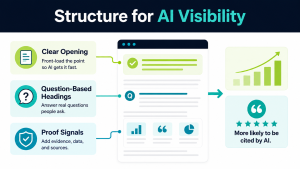
The most direct fix is also the most underused: state the main point in the first paragraph. Not after an introduction. Not after background context. In the opening.
For buyers and AI tools alike, content that buries its value loses the attention of both. A clear opening that names the topic, the audience, and the takeaway signals exactly what the page covers. That makes it easier for AI systems to classify, extract, and cite.
Match the questions buyers actually ask
AI tools are built to answer questions. Content that mirrors natural question phrasing, through clear subheadings and FAQ sections, aligns with the way AI systems process and surface information.
This is not about keyword density. A buyer asking an AI tool which agency handles bilingual SEO expects a different answer format than a buyer typing the same phrase into Google. The content that answers the conversational version earns the citation.
Build proof into the content itself
AI systems prioritize credible sources. Pages with verifiable data, attributed statistics, and documented results are cited more frequently than pages making unsupported claims. Sites that implemented structured data and FAQ schema saw a 44% increase in AI search citations, according to BrightEdge data reported by Superlines.
Proof is not optional in an AI search environment. It is the mechanism by which content earns the trust that drives citation frequency.
How Prospect Factory Structures Content for AI Search
Connecting content strategy with search intelligence
Effective content for AI search does not start with writing. It starts with understanding what buyers are actually asking across platforms and markets.
Our Big Data Social Listening service gives organizations a real-time map of the questions, topics, and concerns their buyers express across social platforms and communities. That intelligence feeds directly into content decisions, so what gets written matches how buyers actually search, not how organizations assume they search.
Our Adaptive and Intelligent SEO practice then structures that content to perform across both traditional and AI-driven search environments. That includes opening structure, subheading architecture, FAQ development, and schema implementation designed to make content easier for AI systems to extract and cite.
The bilingual factor for US and Latin American markets
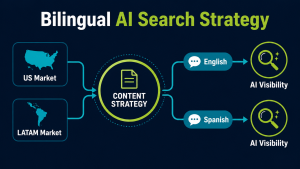
For organizations operating across US and Latin American markets, AI search content carries an added layer. AI tools process queries in both English and Spanish, often returning different sources for each language.
Content that exists only in English, or that translates mechanically without adapting structure and tone, performs differently across AI platforms in each language. Building presence that earns citations in both requires content developed with both audiences in mind from the start.
Our Social Media Contents service extends that content strategy across the social platforms where AI tools also pull source material, reinforcing brand signals across every channel AI systems evaluate.
If your organization wants to assess how your current content performs in AI search environments and where the gaps are, we welcome that conversation. Reach us at prospectfactoryonline.com/contact-us.
Frequently Asked Questions
What is content for AI search?
Content for AI search is web content structured to be discovered, understood, and cited by AI tools like ChatGPT, Perplexity, and Google AI Overviews. These tools generate answers from sources they classify as credible and clearly organized. Content built for AI search states its main point early, uses question-based headings, includes verifiable proof, and applies structured data markup so AI systems can extract and present it accurately.
Does ranking on Google mean my content will appear in AI answers?
Not automatically. Research shows that around 80% of URLs cited by major AI platforms do not rank in Google’s top 100 results for the same query. AI systems evaluate content based on clarity, structure, and credibility signals that differ from traditional SEO ranking factors. A page can rank well and remain invisible in AI-generated answers if its structure does not support AI extraction.
Why does the first part of a page matter so much for AI visibility?
AI tools extract answers from the content they can access most efficiently. Research shows that 44% of all AI citations come from the first 30% of a page. Content that delays its main point with lengthy introductions loses citation opportunities before the AI reaches the useful section. Front-loading the point is the single most direct structural change organizations can make.
Does this apply to B2B organizations?
Yes. B2B buyers increasingly use AI tools to compare vendors, summarize options, and build shortlists before contacting any company. The buyer journey that once started with a Google search and ended on a website now often starts with an AI query that resolves before any website is visited. B2B organizations that do not appear in AI-generated answers miss the earliest stage of the evaluation process.
How does Prospect Factory approach AI search content?
Prospect Factory develops content strategies that start with real buyer intelligence, using Big Data Social Listening to map the questions and topics buyers discuss across platforms and markets. That intelligence informs content structure, subheading architecture, FAQ development, and schema implementation designed to earn citations across both English and Spanish AI search environments.

